
|
 |

|

|


[Related projects and data]
|
Energy transportation and dissipation in the magnetosphere and polar ionosphere | ||
 The upper atmosphere, ranging from about 70 to several million kilometers above the earth, known as geospace, is the outermost region of man's environmental envelope. Geospace comprises the magnetosphere, ionosphere, thermosphere and mesosphere. Although different in structure and composition, these regions are very closely coupled by the magnetic fields, electromagnetic waves and charged particle fluxes that pervade them. The structure and dynamics of geospace are controlled not only by EUV/UV radiation from the sun, but also by the effects of the solar wind and its embedded magnetic field, and by the earth's magnetic field. Most of the solar wind energy transferred into the magnetosphere and ionosphere is deposited in the high latitude regions. One of the energy dissipation processes is the aurora. The geomagnetic field lines converge towards the polar regions. Therefore the polar regions provide a viewing window through which nearly all regions of geospace are remotely sensed.
1. Studies of magnetospheric phenomena 1.1 Magnetopause phenomena
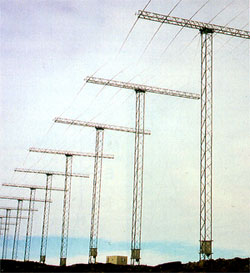
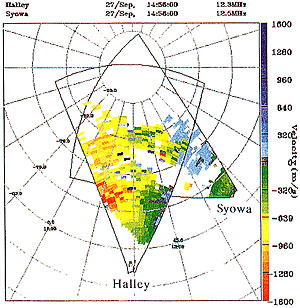
Energy and mass are transferred between the solar wind and the coupled magnetosphere-ionosphere system. The principal elements in the energy transfer process merge at the magnetopause, involving the coupling of the interplanetary and geomagnetic fields. The dayside magnetopause and the cusp regions are known to be very dynamic, where phenomena with time scales of the order of less than a few minutes can occur. We examine the temporal and spatial characteristics of these phenomena, such as FTEs, plasma flow bursts, MHD waves, etc., using SuperDARN HF radars installed at Syowa Station (N. Sato,
H. Yamagishi, A.S. Yukimatu, A. Kadokura), ground-based comprehensive auroral observations at the Chinese Zhongshan Station (N. Sato, S. Okano, H. Yamagishi, M. Kikuchi, A.S. Yukimatu), and monochromatic all-sky auroral TV cameras installed at the South Pole Station (M. Ejiri, S. Okano, M. Okada, M. Taguchi, M. Tsutsumi).1.2 Magnetospheric substorms
The explosive release of energy in the nightside magnetosphere is termed a magnetospheric substorm, causing among other phenomena, a magnificent brightening of the auroras. However, it is still unclear what sets off the explosive phase of substorms or what part is played by reconnection in the tail of the magnetosphere. In order to study the various aspects of substorm phenomena such as particle acceleration, modulation, precipitation, field-aligned current and auroral electro-jet, comprehensive observations from the ground (e.g. SuperDARN HF radars, all-sky cameras, photometers, imaging riometers, magnetometers, ULF/VLF wave receivers), on board balloons (X-ray and electric field observations by Polar Patrol Balloons), and telemetry reception from polar orbitting satellites (Akebono, DMSP, etc.) have been carried out. All the staff in the upper atmosphere physics group participate in this subject.1.3 Magnetic storms
Magnetic storms are the largest disturbances in the earth's
magnetosphere. High-speed solar wind and a southward
interplanetary magnetic field generate large electrical forces
which cause many high-energy charged particles to
penetrate deeply into the inner magnetosphere. This extreme
phenomenon consequently causes, for example, a magnetic
depression at equatorial latitudes and diffuse auroras moving
toward lower latitudes than usual. A recently developed
computer simulation scheme is capable of investigating the
storm-associated phenomena. Comparing the results with
ground and satellite observations will elucidate the physical
processes of magnetic storms (M. Ejiri, H. Miyaoka, and Y.
Ebihara).1.4 Generation and propagation of plasma waves
Radio and plasma waves play a fundamental role in the
dynamics of the magnetosphere and ionosphere. They
provide an efficient mechanism for particle scattering,
acceleration of particles, and energy transportation from the
solar wind into the magnetosphere. The propagation
characteristics of the waves provide the basis of the
diagnostics of geospace parameters such as plasma density
and temperature. In order to study the generation and
propagation mechanisms of the plasma waves in ULF, VLF
and LF ranges, induction magnetometers, imaging
riometers, and VLF and LF radio wave receivers are
installed at Syowa Station, Antarctica and three stations in
Iceland (N. Sato, H. Yamagishi, H. Miyaoka, M. Okada, M.
Kikuchi).1.5 Geomagnetically conjugate studies of auroral phenomena
The geospace environment responds globally to
disturbances in the solar wind. However, the nature of the
response is often different between the two polar regions.
Simultaneous observations in both polar regions therefore
provide critical data. We have been operating
geomagnetically conjugate point observations in the auroral
zone at Syowa Station, and three stations in Iceland
(Husafell, Tjornes and Aedy) since the early 1980s.
Recently, we have extended the conjugate observations in
the polar cap region to Zhongshan Station in Antarctica,
Svalbard and Greenland. These network stations are suited
to studying energy input and dissipation in the
magnetosphere (N. Sato, H. Yamagishi, A. Kadokura, A. S.
Yukimatu, M. Okada).2. Studies on the polar ionosphere
Solar wind interacts with the earth and its magnetic field,
giving rise to the formation of the magnetosphere. Flows of
energy, mass and momentum in the form of particles and
fields enter into the earth's high latitude ionosphere either
from various magnetospheric regions or directly through the
cusp region. They are either dissipated there or further
transported to lower altitudes and latitudes as wave
disturbances. Aurora manifests itself as the highly energized
particles precipitate from the plasma sheet or cusp region
into the polar upper atmosphere. Ionospheric signatures of
interaction and propagation of particles and fields are thus
envisaged in its structural and dynamic disturbances and
offer valuable clues for clarifying the underlying physical
processes. We are specifically studying the following
subjects aiming at unambiguous and consistent delineations
and quantitative numerical descriptions of the facts revealed
by radar, ground-based, balloon, rocket and satellite
observations.2.1 Structure of the polar ionosphere
Electron density in the polar ionosphere increases when
particle precipitation and associated aurora or sometimes
enhanced aurora occur, while it occasionally depletes in the
F-region near the aurora oval edge. EISCAT radar at the
oval and cusp regions can thus probe variations of the
ionosphere plasma and thermospheric structures possibly
related to auroral substorm or disturbed magnetosphere (T.
Aso, N. Sato, M.Tsutsumi).2.2 Dynamics of the polar ionosphere
Atmospheric winds and waves in the polar ionosphere are
influenced both by the dense lower atmosphere and by
electro-dynamic agents connected to the magnetospheric
region. Hydromagnetic tides as well as planetary waves in
the thermosphere are modified due to ion drag, and non-migrating
or local tides are also supposed to exist in the high
latitude region. Gravity waves of both auroral and lower-atmospheric
origins are occasionally observed as a traveling
ionospheric disturbance of electron density. These waves
propagating from below dissipate to contribute to
momentum and heat transfer in the thermosphere. EISCAT
radar can supply these dynamic features in the short term to
climatological bases (T. Aso, S. Okano, K. Sato, M.
Tsutsumi).2.3 Auroral photoemission processes
Aurora is formed by high energy particles impinging on
the polar atmosphere. Its luminous structure is determined
by the particle energy spectrum, atmospheric model and
quenching mechanisms involved. Also its modulation and
deformation directly reflect the plasma process taking place
in the accelerating region. Auroral tomography reconstructs
its 3-D structures using multi-point monochromatic images
taken collaboratively with the Swedish ALIS (Auroral Large
Imaging System). Also, an auroral spectrograph has recently
been installed in Svalbard to study the high-resolution
auroral spectrum in the cusp region. Computer simulation
relying on the Monte Carlo method has been worked out, in
which possible excitation processes are elaborately
modelled and absolute emission intensity is found to
compare well with rocket data from Antarctica (M. Ejiri, T.
Aso, S. Okano, M. Taguchi).2.4 High energy particle precipitations
Precipitating particles generate enhanced ionospheric
electron density as well as aurora excitation, which
eventually cause augmented absorption of cosmic radio
noise incident on the earth. Imaging riometer thus visualizes
spatial distribution of enhanced ionization which offers all-weather
and full-day monitoring of impinging auroral
particles. The result is subject to detailed survey in relation
to auroral substorm and north-south conjugacy of auroral
phenomena (H. Yamagishi, N. Sato).
|


9-10, Kaga 1-chome,Itabashi-ku, Tokyo 173-8515, Japan
Telephone +81(3)3962-4712 / Facsimile +81(3)3962-2529 E-mail:www-editor@nipr.ac.jp
All Rights Reserved, Copyright (c) 1999-2002, National Institute of Polar Research